> ## Documentation Index
> Fetch the complete documentation index at: https://docs.near-intents.org/llms.txt
> Use this file to discover all available pages before exploring further.
# What are Intents?
> Define desired outcomes instead of managing execution steps
An intent expresses **what you want** to achieve, **not how to get it**. Instead of writing code to bridge assets, find quotes, and execute swaps, you submit an intent such as *"I have 1 ETH on Ethereum, I want USDC on Arbitrum"*.
***
## How it works
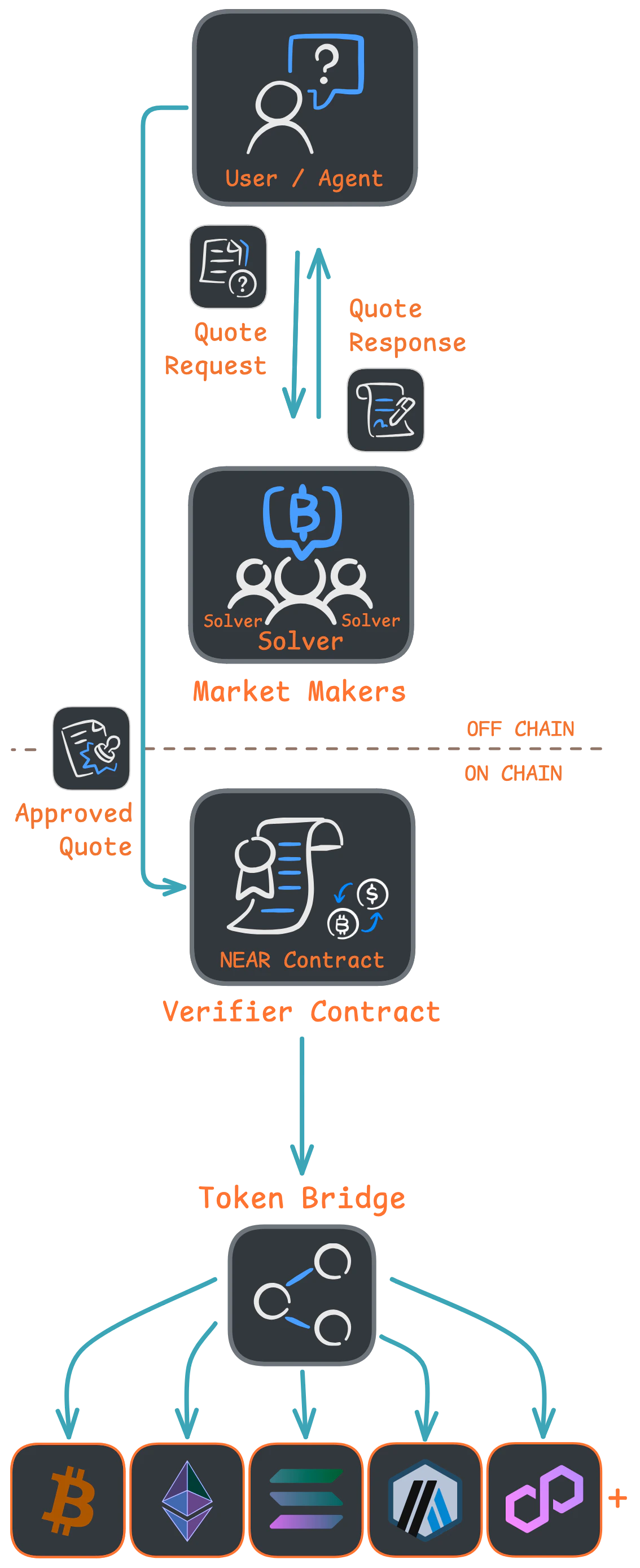
Specify your desired outcome: the tokens you have, the tokens you want, and where you want them delivered.
Multiple market makers bid to fulfill your intent (quote request), competing on price, speed, and execution quality.
Approved quotes are submitted to a smart contract ensuring atomic execution; your swap either completes fully or you get automatically refunded.
Your requested tokens arrive at the destination address you choose, secured by on-chain verification.
***
## Key benefits
Express desired outcomes instead of managing individual steps
Solvers compete to fill orders quickly
Use your existing wallets on any supported chain
Multiple solvers compete on price and execution quality
Funds are returned if the intent cannot be executed
You maintain control of your assets throughout the process
***
## Learn more
NEAR Intents uses atomic execution enforced by smart contracts on NEAR Protocol. Transactions either complete with all conditions met, or they are reverted and funds returned to the refund address. All transactions are verified on-chain before settlement.
NEAR Intents supports major blockchains including Ethereum, NEAR, and others. The list of supported chains and tokens is continuously expanding. Check our [Chain Support page](/resources/chain-support) for the current list.
The 1Click API charges 0.2% (20 basis points) for unauthenticated requests. Authenticated users (with JWT tokens) pay no platform fees—only network gas costs and market maker spreads. [Learn more about fees](/resources/fees).
When you create an intent, it is broadcast to multiple market makers who bid to fulfill it. They compete on price, speed, and execution quality. The best execution path is selected while ensuring the intent's terms are met.
***
## Additional Resources
Explore the technical architecture and design philosophy behind NEAR Intents in this comprehensive blog post.
Learn the basics of what NEAR Intents are and how they work in this video overview.